

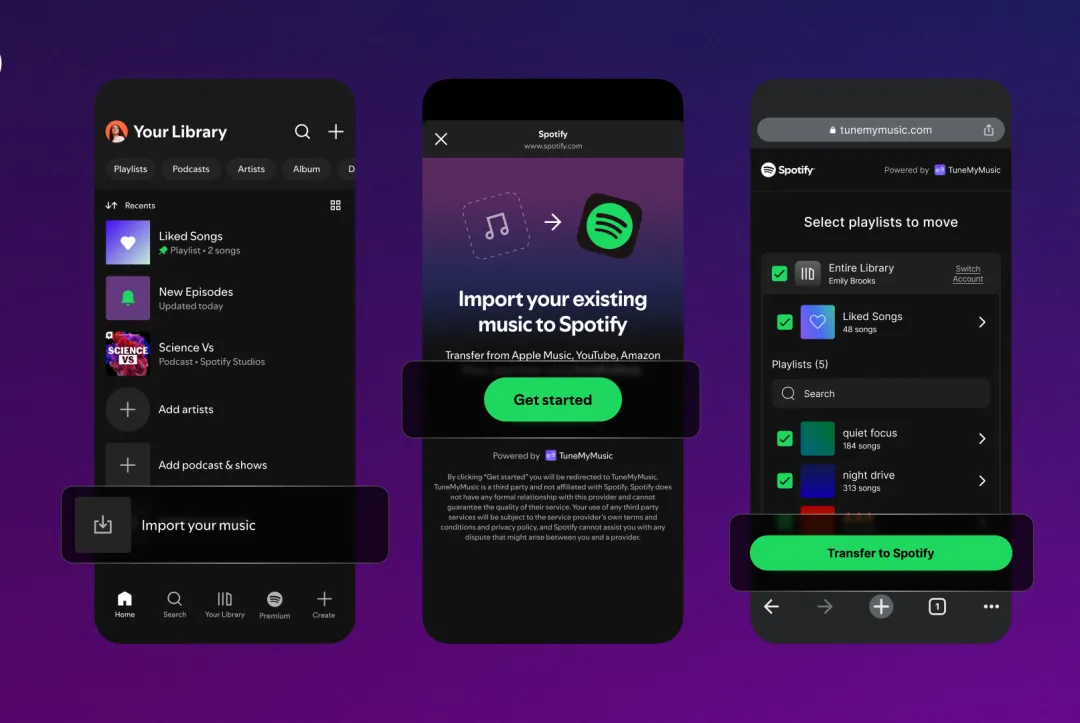
Spotify has introduced a new tool that allows users to transfer playlists from competing music platforms directly into its app, eliminating the need for third-party services.
The update removes years of friction for listeners who avoided switching apps due to migration difficulties.
Spotify playlist imports now work without the need for third-party tools. This was a longstanding dependency for users transitioning from Apple Music (United States), YouTube Music (Google, United States), and Tidal (Norway).
The new system preserves track order, flags unavailable songs, and supports bulk transfers.
The move comes as Spotify playlist imports become increasingly important in the crowded music-streaming market, where platforms are competing not just on catalog size but on usability.
Analysts say playlist portability has been one of the strongest retention barriers in the sector.
Spotify playlist imports are launching amid broader digital infrastructure pressure resulting from global AI adoption. According to new research from Cisco (United States), 91 percent of organizations are increasing network investments to handle AI workloads.
Meanwhile, 71 percent say their current data-center capacity is insufficient.
These findings suggest that Spotify playlist imports fit into a broader trend. In this trend, consumer apps refine user experience while enterprises rebuild backend infrastructure.
Cisco executive Anurag Dhingra said AI “generates information at machine speed, increasing the need for human oversight and strong connectivity.”
ALSO READ
Spotify playlist imports also highlight how user expectations have evolved in the AI era.
As workplaces, content platforms, and cloud services accelerate automation, consumers increasingly expect seamless data portability between digital ecosystems.
With Spotify playlist imports now simplified, the company’s strategy appears focused on reducing churn and making it easier for subscribers to test new features such as AI-generated playlists and recommendation tools without risk of losing existing libraries.
Industry observers expect Spotify playlist transfers to become standard across the sector, putting pressure on rival platforms to enhance their own migration paths.
Improved interoperability could shift competitive dynamics as switching costs decrease globally.
Looking ahead, Spotify playlist imports may expand to support additional media formats as digital-policy debates in the European Union and the United States continue pushing for data portability rights across consumer platforms.


