



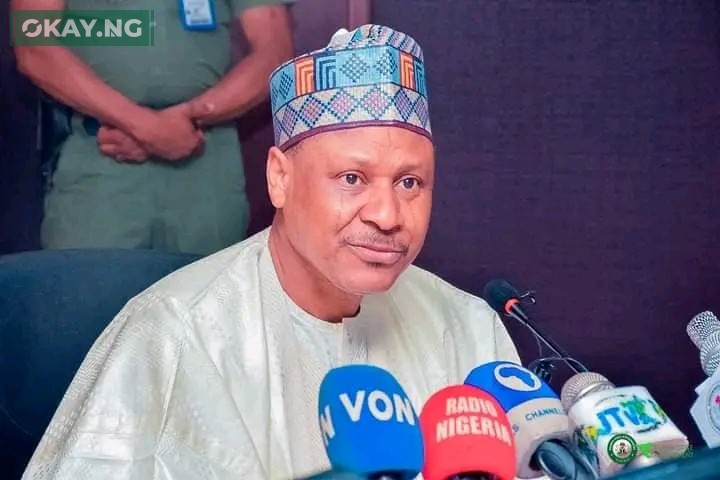
The Minister of Information and National Orientation, Mohammed Idris, has declared that the bold economic surgical procedures initiated by President Bola Tinubu are effectively stabilizing the nation, restoring global investor confidence, and averting a total economic breakdown.
Speaking during a virtual interview on ICAN On Air—a live program hosted by the Institute of Chartered Accountants of Nigeria, the Minister emphasised that the administration’s focus on long-term stability is finally yielding measurable results.
Reflecting on the state of the nation prior to the current administration, Idris revealed the grim reality that necessitated the removal of fuel subsidies and the unification of foreign exchange rates.
“You cannot build an economy where the foundation itself is extremely faulty,” the Minister stated.
He noted that as of May 2023, Nigeria was on the brink of insolvency, with 97 percent of national income swallowed by debt servicing and 26 out of 36 states unable to meet basic salary obligations.
“These were not politically convenient decisions, but the President believed we were living on borrowed time,” Idris added. “If those steps were not taken, Nigeria was heading in the wrong direction.”
Despite the initial “short-term shocks” experienced by citizens, the minister pointed to several indicators suggesting an economic turnaround.
He said Nigeria’s foreign reserves had risen to about $46 billion, the highest level in nearly eight years, while headline inflation was recording a notable downward trend.
READ ALSO
He also noted that Nigeria’s recent exit from the Financial Action Task Force (FATF) grey list had restored global confidence and reopened access to international capital markets.
On tax reforms, Idris clarified that the measures were aimed at widening the tax net and eliminating double taxation, not increasing the financial burden on the average Nigerian.
Beyond the balance sheets, the Minister identified “trust” as the administration’s most critical currency.
He described his primary mandate as fostering a transparent relationship between the government and the governed, noting that Tinubu actively seeks and acts on public feedback.
Addressing the rise of digital threats, Idris warned that fake news poses an existential risk to national stability.
To combat this, he highlighted Nigeria’s successful bid to host UNESCO’s first Category-2 Media and Information Literacy Institute, a move intended to equip the youth with tools to verify information.
The Minister urged Nigerians to remain steadfast as the benefits of these “deliberate and disciplined” reforms continue to manifest in healthcare, education, and infrastructure.
“We are on the right journey, and the signs are already clear,” he concluded.