

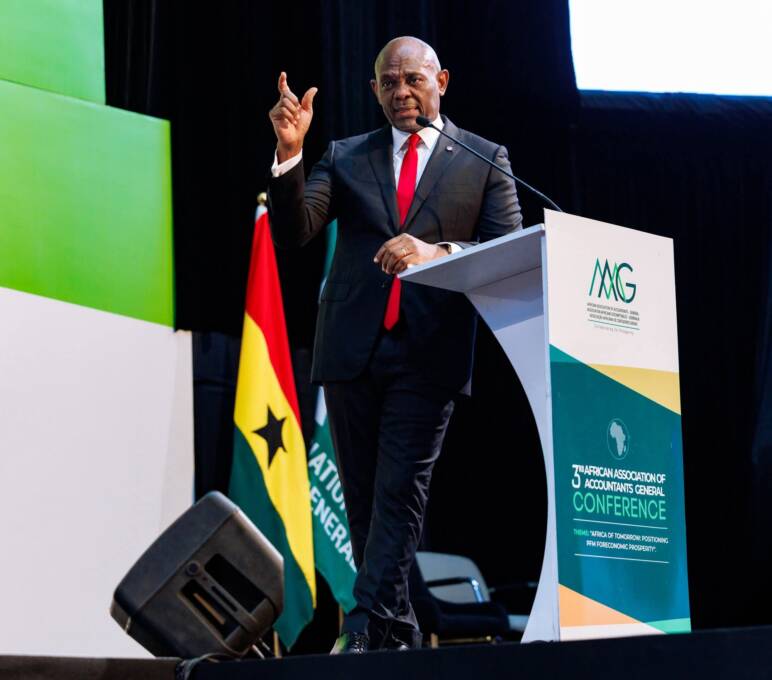
Entrepreneur Tony Elumelu has said Africa is facing a critical moment where action must replace talk.
Speaking at the African Association of Accountants General (AAAG) Annual Conference in Ghana, Elumelu emphasized that the continent is one of “urgency,” not just potential.
Elumelu, a firm believer in the economic philosophy of Africapitalism—which posits that the private sector must collaborate with the public sector to drive Africa’s transformation—addressed the Accountants General, Africa’s financial stewards.
He pointed out a significant paradox: Africa faces an estimated $100 billion annual infrastructure gap while simultaneously possessing vast amounts of capital.
“Our problem is not money, it is trust. Trust built through predictability, transparency, and partnership.”

He cited sources of available capital, including: over $4 trillion in pension and sovereign funds, and over $100 billion in diaspora remittances annually.
Elumelu stressed that the Accountants General hold the key to unlocking investment, noting that if governments can ensure predictability, transparency, infrastructure, and support for long-term investment, Africa will be transformed.
READ ALSO
Drawing from his own business ventures, Elumelu highlighted how long-term investment guided by Africapitalism has created impact.
He said UBA Group has grown from a national bank to a global institution, serving over 50 million customers across Africa, Europe, America, and the Gulf, and directly creating over 40,000 jobs.
Elumelu added that Transcorp Group invested in Nigeria’s power generation sector when others deemed it risky, and now produces 15% of the nation’s power.
The Tony Elumelu Foundation has supported 24,000 young entrepreneurs across all 54 African countries with over $100 million in non-refundable seed capital.
These entrepreneurs have collectively created over 1.5 million jobs and generated over $4.2 billion in revenue.
Elumelu stated that Africapitalism is about the private sector taking responsibility for Africa’s development, resulting in a continent “built by its own ideas, its own entrepreneurs, and its own systems.”
He reiterated that partnership, trust, transparency, equity, and shared prosperity must be the foundation for Africa’s future.


