

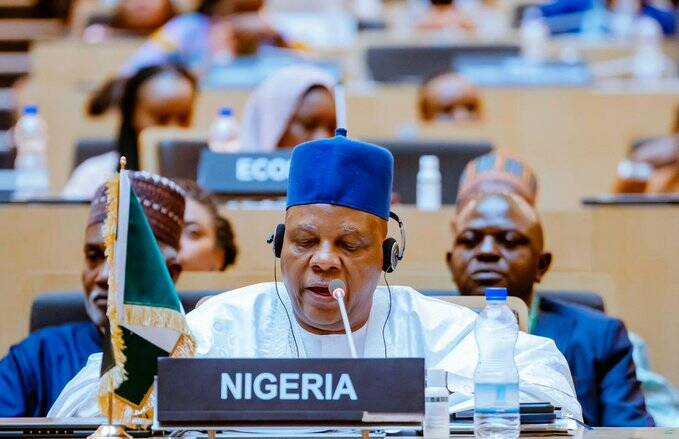
Nigeria has backed a comprehensive reform of the African Union’s institutional framework, prioritising a total overhaul of peace and security governance, the strengthening of democratic institutions, and the stabilisation of the continent’s economy.
Representing President Bola Tinubu at a closed-door session of the 39th Ordinary Session of the African Union Assembly in Ethiopia, Vice President Kashim Shettima declared Nigeria’s alignment with restructurings aimed at boosting regional resource mobilisation and reducing continental inequality.
A major highlight of the endorsement is the support for the Combined Maritime Task Force (CMTF) for the Gulf of Guinea.
Recognising it as a vital standby force, Nigeria pledged to provide the essential backbone for its operations.
As the host of the task force headquarters, Nigeria will provide office facilities, ships, and helicopters.
The nation will deploy temporary staff to ensure the force can provide rapid, coordinated responses to maritime threats.
Shettima identified the proliferation of small arms and light weapons as the primary driver of violent extremism, urging the AU to refocus on curbing these trends.
READ ALSO
In a move toward regional reconciliation, he endorsed the AU’s decision to lift the participation bans on Gabon and Guinea.
“Nigeria welcomes Gabon and Guinea back to our union after the completion of their political transitions. We call on other countries with protracted political transitions to follow the approach to return to the fold,” Shettima stated.
Nigeria’s position at the summit emphasised that Africa’s mineral wealth must serve as a “strategic asset” for local industrialisation rather than just for export.
He called for coordinated continental strategies to ensure mineral extraction supports local processing and technology development.
Nigeria proposed regular briefings by African mining ministers to ensure transparency in the sector.
Nigeria welcomed the G20 Ubuntu approach to food security, calling for greater investment in research, climate-resilient agriculture, and support for women and youth smallholder farmers.
Nigeria further associated itself with innovative proposals to review the criteria for membership in the Peace and Security Council (PSC).
The goal is to ensure better coordination between the AU and Regional Economic Communities (RECs).
Shettima also emphasised the importance of a stronger connection between the PSC and the C-10 Committee, the Committee of 10 Heads of State on UN Security Council Reform, to amplify Africa’s voice in global governance.
Nigeria anchored its African Union endorsement on four key pillars. On security, it pledged the deployment of a Maritime Task Force and support for the AU Standby Force to strengthen regional stability.
On democracy, it is committed to strengthening institutions and ending unconstitutional changes of government across the continent.
On the economy, Nigeria advocated for the local processing of minerals and the provision of affordable development financing to drive sustainable growth.
On equality, it called for the adoption of data-driven frameworks aimed at reducing poverty across Africa.
The 39th AU Summit concludes with Nigeria reaffirming its role as a lead implementer of these reforms, aiming for a more integrated, secure, and self-sufficient Africa.


