

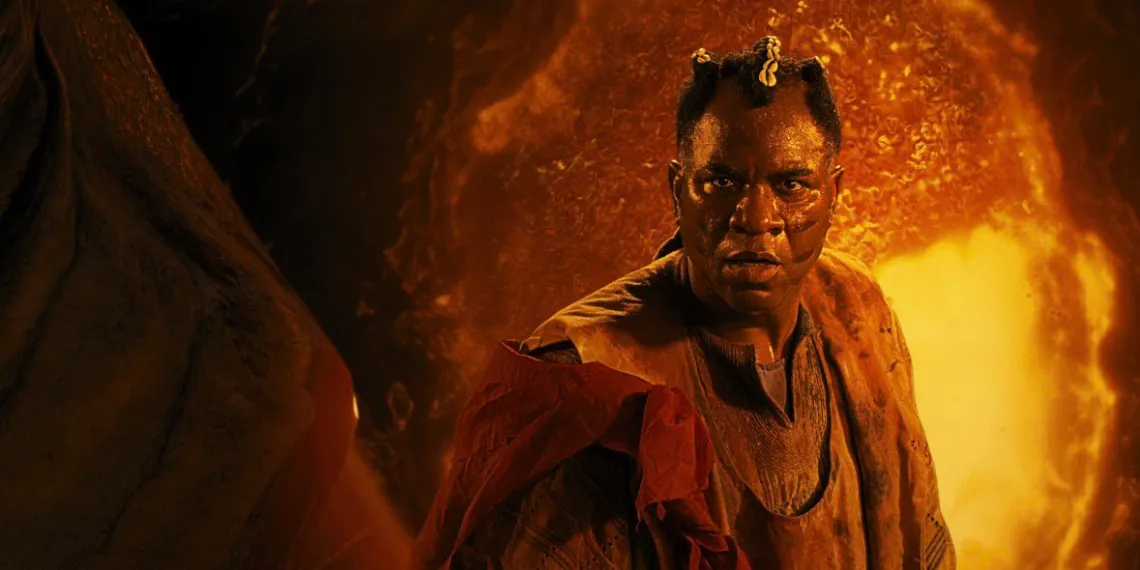
Aníkúlápó 2 is a good work of cinema, but it is not an easy one. The season is not boring in the sense people often suggest. Rather, it is demanding. It asks the viewer to slow down, to pay attention, and to engage with Yoruba history and cosmology on their own terms. For an audience used to speed, spectacle, and instant payoff, this demand can feel uncomfortable.
I do not believe the film was made with Gen Z viewing habits in mind. It does not rush to entertain, and it does not simplify itself. It behaves more like an old Yoruba oral narrative, deliberate, layered, and patient. This alone explains why reactions have been mixed. Some viewers experience the pace as heavy, while others recognise it as intentional. In traditional Yoruba societies, power did not always move quickly. It moved through ritual, silence, fear, alliances, and delayed consequences. The series reflects that historical reality.
One thing the season does well is its cultural confidence. It does not dilute Yoruba cosmology to fit modern expectations. It trusts that the world it presents has its own internal logic, even if that logic is unfamiliar to some viewers. This is especially clear in the spiritual elements of the story. Many people ask why Ogundé’s son returns after death. To those unfamiliar with Yoruba belief systems, this may seem illogical. To those grounded in them, it is not strange at all. In Yoruba thought, death is not always closure. Certain deaths create imbalance rather than resolution. What returns is often not redemption, but warning.
ALSO READ FROM THE SAME AUTHOR
- Insecurity: Which state is next?
- Zaidu Sanusi needs tactical protection, not blind loyalty
- Edos and Yorubas: Siblings in history, strangers in identity
This is where the film becomes somewhat political. It reflects on abuse of power in pre-colonial society, particularly by warriors and rulers whose authority went unchecked. The story suggests that unresolved injustice does not simply disappear. It lingers, mutates, and eventually demands reckoning. In that sense, the supernatural elements are not fantasy. They are metaphors rooted in historical memory.
Visually, Aníkúlápó 2 is strong. The cinematography is superb. The palaces feel heavy rather than glamorous. These choices work well and show a director who understands the sensitive richness of Yoruba drama. Sometimes it teaches through stillness. The production design and atmosphere carry the weight of the story effectively.
Where I think the season struggles is in narrative focus. There are many ideas, characters, and subplots, but not enough pressure forcing them into a clear collision. Yoruba epic storytelling can accommodate many strands, but it usually has a clear emotional centre anchoring the audience. Here, that centre feels diffused. As a result, the viewer often admires the ambition and scale of the story without being fully carried by a single character’s journey.
The expansion of the story beyond one kingdom is one of the season’s most promising moves. By widening its geographical and political scope, the series hints at a larger historical moment shaped by trade, rivalry, and the early shadows of external influence. This is important because it challenges the idea of isolated kingdoms and reminds us that internal power struggles and external pressures were deeply connected. Still, ambition needs discipline. Too many narrative threads are introduced without being resolved with enough clarity or consequence. The issue is not that the story is too deep, but that it sometimes lacks focus. Fewer strands, sharper conflicts, and a clearer guide through the world would strengthen the drama without sacrificing its cultural depth.
This is my piece of advice to Mr Kunle Afolayan for the next season. For the next installment, I think the task is not simplification but refinement. The series needs to decide whose journey truly anchors the story and allow other elements to revolve around that core. Yoruba cosmology does not need to be explained away, but it can be made more legible through clearer storytelling choices.


