
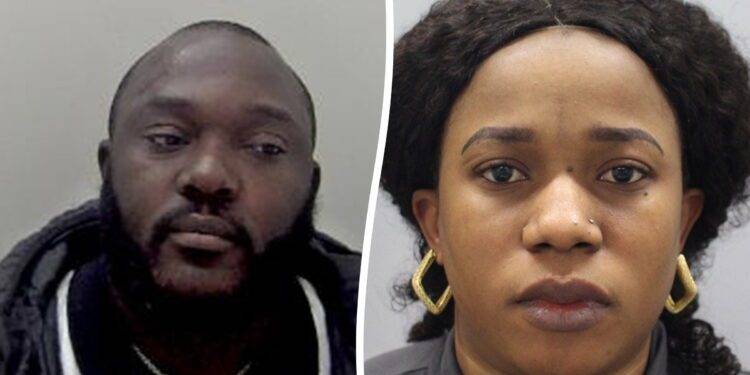
A husband and wife have been sentenced to prison after they were found guilty of stealing the personal details of more than 100 Transport for London (TfL) employees and using them to fraudulently claim hundreds of thousands of pounds in tax rebates.
Luciana and Femi Akanbi were convicted after a court heard they carried out a large-scale fraud involving sensitive staff information obtained through Luciana’s access as a TfL employee. The court described the scheme as the most severe data breach in the organisation’s history.
Luciana Akanbi, 38, worked in TfL’s human resources department, where she was able to access confidential employee records. Prosecutors told Woolwich Crown Court that she and her husband exploited the passport numbers, national insurance details and bank information of 40 employees to submit 139 fake tax rebate applications to HMRC.
The fraudulent activity, which took place between September 2021 and January 2022, resulted in a loss of about £433,000 to the public purse, although the total attempted claims amounted to nearly £650,000.
Both defendants, who reside in Dartford, Kent, received identical prison sentences of three years and nine months.
During sentencing, Judge David Miller condemned the scale and impact of the offence, stating: “TfL suffered their worst ever data breach.
“It meant they had to change their systems. It affected their morale, I am told, and staff performance.
“You acquired and used the personal details of 40 employees in relation to making the claims for tax rebates, but accessed [the details of] 107 [employees].
“There were 139 claims in respect of 40 employees by self-assessment accounts being set up by you and others, using 38 computer devices from your own home and others.
ALSO READ
“The effect was that there were 139 claims for tax rebates totalling just under £649,000.
“The money lost to HMRC amounted to just over £433,000.
“That money was almost instantly dissipated in a complex money laundering scheme.”
The court heard that Luciana’s access to TfL systems allowed the pair to gather data from 107 employees in total, which was later used to support fraudulent tax claims. Prosecutors said the operation was carefully organised and involved multiple participants and devices.
Andrew Evans, the prosecutor, described the case as highly coordinated and damaging, saying: “The fraud was sophisticated in nature, required significant planning and involved a large number of victims,” he said.
“[Luciana Akanbi’s] fellow colleagues were subjected to additional checks and procedures that lowered morale and created distrust.
He also told the court that after her arrest, Luciana Akanbi attempted to deflect blame by suggesting that her husband’s cousin, an IT professional, may have been responsible for accessing TfL systems.
Femi Akanbi was described by prosecutors as a key link in moving information that enabled the fraudulent claims. The court also heard that he had experienced financial difficulties following the Covid-19 pandemic and had struggled with gambling addiction after a period of illness.
Further detailing the abuse of trust, Judge Miller said: “This is a fraud whereby the personal records and national insurance numbers, bank details and passport numbers of employees of TfL were accessed by you, Luciana Akanbi.
“You had been employed [by TfL] since 2017. By 2021, you were a business service call advisor.
“You had access to TfL’s systems and personal records. 107 personal records were accessed.
“These were later used by both of you and others to claim tax rebates from HMRC.”
The court also heard that £66,000 was deposited into Femi Akanbi’s account and £16,000 into Luciana’s, although the judge noted that the true benefit to them was likely higher.
“You were jointly responsible for not only the intended loss but the actual loss to the public purse.
“Your role, Luciana Akanbi, was that as a trusted employee with access to this data, you abused the trust of your employers.
“Mrs Akanbi was under pressure from you, [Femi Akanbi]. You are equally culpable for the abuse of trust at her place of work.
“I have described how information was harvested and the complex dissipation of the money.
“You two were at the epicentre and this fraud was only possible because you, Luciana Akanbi, had access to this personal, private information.
“You, Luciana Akanbi, had been colleagues with some of these people who were extremely badly let down.
“That is damaging; to have your credit ratings impacted, to deal with HMRC and to have to rearrange your finances. There was immense damage to third parties.
“Both of you have worked hard to look after your children. You were under financial pressure and [Femi Akanbi] took to gambling.
“You fell foul to that addiction. Over £50,000 was paid into different gambling accounts.
“In both of your cases, the sentence is one of three years and nine months.
“You may be liable for deportation, but that is not for me.”
🔍 Explore More
- NRTC English Knowledge Base – Learn, improve, and sharpen your English skills.
- Top Stories From Around the World – Stay informed with the latest global news and insights.
- Specially Curated Listicles – Discover interesting lists, guides, and deep dives selected for our readers.
- Stay Updated: Join our mailing list and never miss the latest articles and updates from NRTC.
The judge added that the stolen funds had already been spent and recovery was unlikely, noting: “I cannot get blood from a stone,” he commented.
Reacting to the verdict, Richard Mullings, Head of Counter-fraud & Corruption at TfL, said: “We take any cases of fraud extremely seriously and welcome the court’s sentencing of these two individuals.
“This crime meant that hundreds of thousands of pounds was unable to be reinvested elsewhere to the wider public benefit, and involved working closely with HM Revenue and Customs to secure a successful prosecution.
“We are also grateful to the victims for their support throughout this case, and for reporting it so it could be investigated.
“We immediately notified the Information Commissioner’s Office and can reassure those working for us that we have since introduced a range of measures to further tighten up access to personal staff data and ensure this cannot happen again.”
An HMRC spokesperson added: “This should act as a warning to others that we can and do act against anyone who tries to undermine the tax system and steal money that funds public services.
“We’d urge anyone with information about any type of tax fraud to report it to HMRC on GOV.UK.”