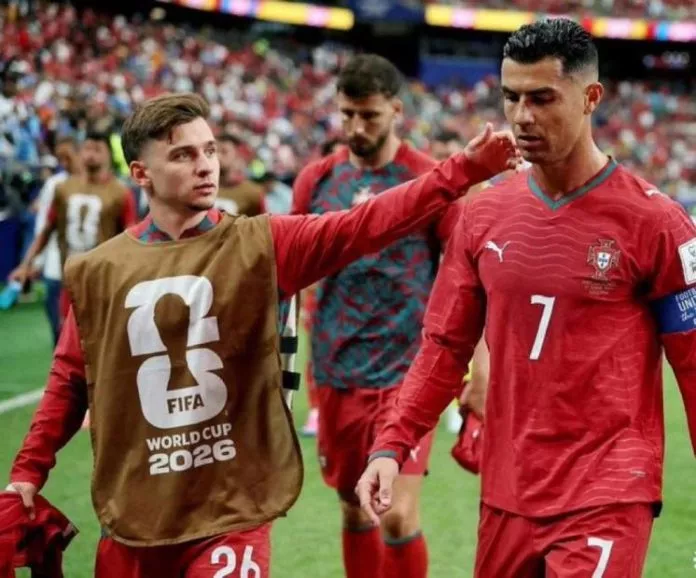





FIFA’s mandatory hydration breaks have sparked a furious backlash at the 2026 World Cup.
The three-minute stoppages, introduced for player welfare, are now being exploited as tactical timeouts by coaches. Fans are booing the pauses across multiple venues, while top players, including Virgil van Dijk, have condemned the rule as a commercial ploy.
Referees are instructed to halt play for exactly three minutes at the 22nd minute of each half. The rule applies uniformly across all 104 matches, regardless of weather conditions or whether a stadium is air-conditioned.
Fans express disgust
Loud boos all around Dallas Stadium during England’s clash with Croatia when referee Clement Turpin signalled the first break. England fans had vowed to protest the innovation on social media.
The hydration break received an equally cold reception in Toronto, where Ghana faced Panama. Fans booed as players walked toward their benches while a steady rain poured down.
Norway’s match against Iraq in Boston also drew boos. The temperature was a mild 23 degrees Celsius (73.4 degrees Fahrenheit).
Coaches use breaks as tactical timeouts
Managers have openly acknowledged using the stoppages for tactical discussions. Netherlands coach Ronald Koeman said the breaks provide an opportunity to relay instructions that would otherwise be difficult during play.
Switzerland boss Murat Yakin admitted he used the second-half hydration break to time his substitutes because “then the opponent can’t react”.
England manager Thomas Tuchel insisted the breaks were unnecessary in indoor conditions but admitted they gave him a chance to “regroup, change and reset”.
Germany head coach Julian Nagelsmann indicated the first-half break proved invaluable after his side conceded an equaliser against Curacao. Germany regrouped and scored twice before halftime on the way to a 7-1 win.
Data shows momentum Shifts
Goals were scored within 10 minutes of the restart in eight of the first 16 matches. Curacao felt the shift most painfully. Livano Comenencia had just equalised against Germany when the break arrived. Alan Shearer said the stoppage “killed their momentum”.
Morocco had a similar experience against Brazil, scoring before the break and conceding less than 10 minutes after play resumed.
Panama coach Thomas Christiansen said: “If you have a break, it’s to do corrections. It was not hot, but we have to accept that the advertisers on television [are] what’s paying for all these things.”
Van Dijk leads player criticism
Netherlands captain Virgil van Dijk launched a scathing critique after his side’s 2-2 draw with Japan, played inside the air-conditioned AT&T Stadium.
“Hydration breaks are a bit interesting,” Van Dijk said. “Every time going to commercial is a bit … Not really that I like it. I think for the neutral watchers on TV it’s also not great.”
He argued the breaks should be implemented on a game-by-game basis. “If it’s really hot, obviously it would be good to put them in. But I think you have to look at it in every game, separately.”
- Haaland wins third Premier League Golden Boot
- WAFCON 2024: Esther Okoronkwo wins Fans’ Player of the Tournament
- Premier League: Cole Palmer wins September Player of the Month award
- FIFA confirms halftime show for 2026 World Cup final
Broadcasters cash in
In the United States, Fox has cut directly to full-screen advertisements during the hydration breaks. During the opening match, Fox aired commercials and returned late, causing viewers to miss the restart.
FIFA gave broadcasters the green light to air commercials during the pauses in March, a decision that has fuelled accusations that the rule serves a commercial purpose.
Gary Neville warned: “I think FIFA are going to have to act quite quickly now. It’s effectively a mini-half-time, four quarters. I am surprised it’s not been stamped on pretty quickly, and I think it is a stealth advertising break.”
Roy Keane added, “We love football because of the pace of the game. What it’s doing is stopping the flow of the game, the momentum.”
|| Football Prediction Giveaway Terms || NRTC Internship || Premier League Scores & Fixtures
France coach Didier Deschamps captured the mood: “It is not two halves anymore. It is almost four quarters.”
FIFA has not indicated whether the policy will remain beyond this tournament.