
The situation where your brain lies to you is termed cognitive biases. Cognitive biases are systematic errors in thinking that occur when our brain uses shortcuts (heuristics) to save time and energy. Our brain has developed in such a way that it makes quick judgments for survival, but oftentimes such judgments mislead us.
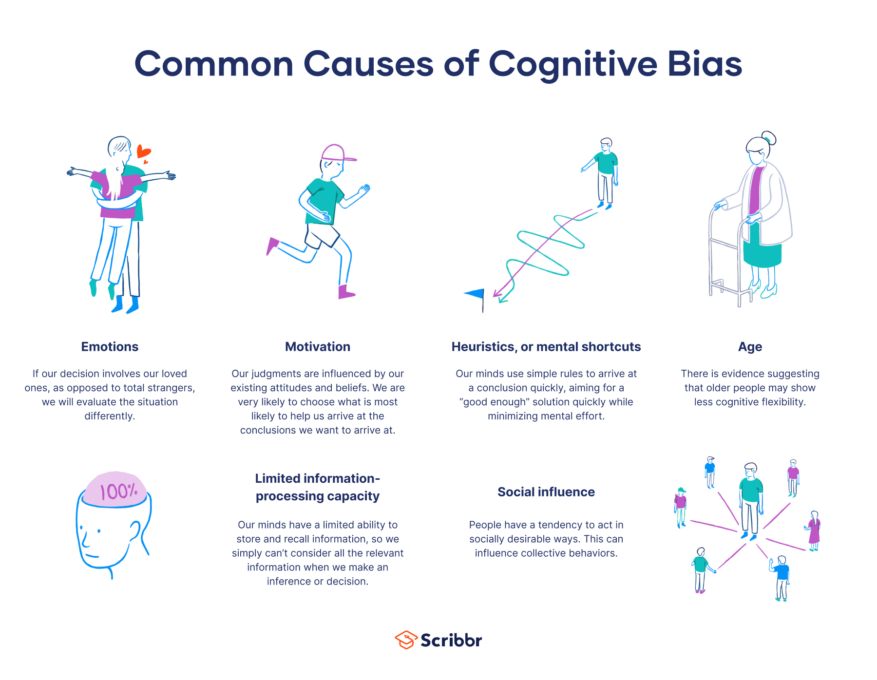
These biases or judgments affect everything. From how we interpret news and events, judge people, remember events, and lots more. They are caused by the process by which our brain simplifies complex information. They arise from mental shortcuts (heuristics), memory limits, emotional influences, and social pressures that help us make quick decisions but often distort reality. These glitches include, but are not limited to:
1. Confirmation bias
The confirmation bias is the tendency to seek, interpret, and remember information that confirms what you already believe, while ignoring evidence that contradicts it. For instance, you believe a certain herbal tea cures headaches. You’ll notice every time you drink it and feel better, but ignore the times you drink it, and the headache persists. Also, on social media, people often follow pages that align with their political views, reinforcing their beliefs instead of challenging them.
2. Anchoring effect
This glitch occurs when we rely too heavily on the first piece of information (the “anchor”) when making decisions, even if it’s irrelevant. For example, if a shop shows a jacket “originally ₦50,000, now ₦25,000,” you’ll think it’s a great deal because the anchor (₦50,000) makes ₦25,000 look cheap, even if the jacket’s true value is closer to ₦20,000.
ALSO READ
3. Availability heuristic
This basically means judging the likelihood of events based on how easily examples come to mind. You think events are more common if they are easier to recall. For instance, after hearing constant news about kidnappings in Nigeria, you might overestimate the chance of being kidnapped yourself, even though statistically it’s less likely than everyday risks like road accidents.
4. Spotlight effect
When you notice a person overestimating how much other people notice or care about your actions, appearance, or mistakes, the spotlight effect is in effect. So basically, you spill a drink at a party and feel like everyone is staring at you. In reality, most people are busy chatting and barely notice. This glitch makes you assume everyone notices your mistake, but in reality, most people don’t.
5. The Mandela effect
The Mandela effect happens when many people collectively misremember something as being different from reality. In essence, your brain confidently remembers something that never was or happened. For example, globally, many people remember the children’s book series as “The Berenstein Bears” instead of the correct “The Berenstain Bears.”
6. Attentional bias
This happens when you fixate on emotionally charged details and miss neutral but important ones. It comes into play when your attention is disproportionately focused on certain things, often influenced by emotions or concerns. In essence, if you’re anxious about money, you’ll notice every conversation about salaries or prices, while ignoring other topics. A student worried about failing might only notice questions they struggled with, not the ones they answered correctly.

7. Paradox of choice
This phenomenon posits that having too many options can make decision-making harder, leading to anxiety or dissatisfaction. More options make you less satisfied. For instance, at a supermarket, you see 20 different brands of noodles. Instead of feeling happy about the variety, you feel overwhelmed and worry you’ll pick the “wrong” one. Later, even after buying, you wonder if another brand would have been better.
These glitches not only shape our everyday decisions but also explain why humans often feel irrational, anxious, or indecisive. Knowing and being able to recognise them helps us to spot when we are being tricked by our brain and make clearer decisions.