




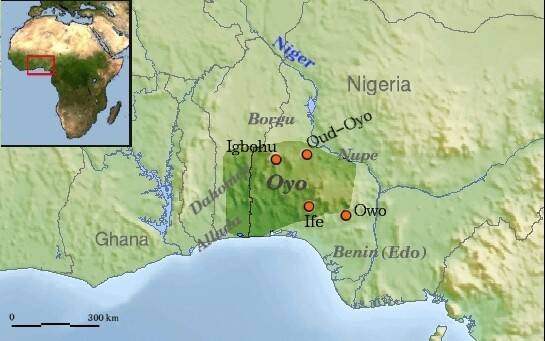
The Oyo Empire was one of the most influential political formations in precolonial West Africa. From the seventeenth to the late eighteenth century, it exercised authority over a wide territory stretching from present-day southwestern Nigeria into parts of what is now the Republic of Benin, while extending military and commercial influence beyond these areas. Its strength rested on effective administration, control of long-distance trade, and military organisation, particularly the use of cavalry, which gave Oyo speed and reach during its imperial expansion.
At the centre of this system stood the Alaafin of Oyo, who functioned as both political and military leader. Yet the Alaafin was never an absolute ruler. Institutions such as the Oyo Mesi and the Ogboni acted as checks on royal authority, ensuring that power was exercised within established norms. Governance in Oyo was therefore institutional and negotiated, not personal or unchecked.
With respect to the limits of Oyo’s dominance, even at its height, the empire did not fully absorb all Yoruba polities into a single political unit. While Oyo exercised firm authority over some external territories, particularly in parts of present-day Benin through tribute relationships, many Yoruba centres such as Ife, Ijebu, Egba, Ondo, Ekiti, and others retained varying degrees of political autonomy. Yorubaland historically functioned as a constellation of related but independent states, connected by language, culture, and shared origin traditions rather than by permanent political subordination to one centre.
The decline of the Oyo Empire began in the late eighteenth century and deepened in the early nineteenth century. Internal political rivalry weakened central authority, particularly tensions between the Alaafin and the Oyo Mesi. Economic disruption and changing trade patterns further undermined stability. A decisive turning point came with the rebellion of Afonja of Ilorin and his alliance with Fulani forces. By the early 1830s, Old Oyo (Ọ̀yọ́-Ilé) had been destroyed and abandoned. The empire collapsed as a functioning political system, not merely as a symbol.
The collapse of Old Oyo did not, however, erase Oyo’s political identity. Rather, it initiated a period of displacement and reorganisation. Members of the Oyo royal household, leading chiefs, military figures, and their followers moved southward and temporarily regrouped at a settlement known as Ago, often identified in historical accounts as Ago Oja, reflecting its role as a transitional base rather than a permanent capital. From this regrouping point, Oyo political authority was gradually reconstituted under Alaafin Atiba, leading to the founding of New Ọ̀yọ́ (Ọ̀yọ́-Àtìbà) in the mid-nineteenth century.
This survival was not achieved independently. Ibadan played a crucial role in protecting and supporting the re-established Ọ̀yọ́ monarchy. By this period, Ibadan had emerged as a dominant military power, and its backing enabled the Alaafin to maintain royal continuity. This relationship marks an important historical shift. Ọ̀yọ́ survived not as an empire commanding others, but as a kingdom sustained within a new balance of power in Yorubaland, where authority had become dispersed among several regional centres.
After the fall of Old Oyo, the imperial capital of the Oyo Empire, authority no longer flowed from a single centre that once coordinated power across much of Yorubaland. Old Oyo had been located in an area of open land where horses and armies could move with relative ease, giving the empire a military advantage and speed. Once that centre collapsed, there was no longer one place from which political and military control could be exercised over the entire region.
ALSO READ FROM THE SAME AUTHOR
- Zaidu Sanusi needs tactical protection, not blind loyalty
- Abandoned houses, abandoned questions: A personal reflection from South-West Nigeria
- Insecurity: Which state is next?
Power shifted southward into areas that today correspond broadly to Ibadan, Ekiti, Ijesa, Ondo, and parts of Egba territory. These areas were marked by thick vegetation, narrow footpaths, hills, and scattered settlements. In such conditions, wars could not be resolved quickly. Armies advanced slowly, and supplying fighters over long distances was difficult, and conflicts often settled into extended periods of waiting, skirmishing, and stalemate rather than decisive victories.
This shift reshaped the nature of warfare and leadership. Control now depended less on speed and cavalry strength and more on endurance, local alliances, access to food, and the ability to remain in the field for long periods. Warfare became sustained and exhausting rather than swift and commanding. The Kiriji War of 1877 to 1893 illustrates this later reality. The conflict lasted many years, not because the participants lacked organisation or resolve, but because terrain and fragmented political authority made quick resolution unlikely. Although the Kiriji War occurred decades after the collapse of Old Oyo, it reflects the kind of prolonged and resource-draining conflicts that became common once imperial authority had disappeared and no single centre could impose order across Yorubaland.
Colonial rule introduced another fundamental transformation. From the late nineteenth century, British indirect rule dismantled indigenous sovereignty and subordinated traditional rulers to colonial administrators. Kingship was redefined from political authority to cultural leadership. This shift continued after Nigerian independence in 1960. Under the constitutional order, traditional rulers hold no executive power. Their influence is cultural, moral, and advisory rather than governmental.
State creation beginning in 1967 further reshaped Yoruba traditional authority. Yorubaland was divided into multiple states, each governed by elected officials. State governments now possess legal authority over traditional institutions. Governors recognise, regulate, and formally install kings through state laws. Traditional rulers exercise authority only within their local jurisdictions and do so under the supervision of state governments. Their relevance is authoritative in cultural terms, not sovereign in political terms.
Within contemporary Yorubaland, there are recognised classes of obas, often described administratively as first-class, second-class, and third-class rulers. These classifications reflect protocol and state recognition, not imperial hierarchy. Regardless of rank, all obas remain subject to the authority of the state governments under which they operate. No ruler holds constitutional supremacy over others. The fact that some rulers share historical antecedents with the Oyo imperial past does not translate into present-day domination. Shared history does not confer modern political authority.
The Roman Empire offers a useful historical parallel. At its height, Rome dominated much of Europe, North Africa, and the Middle East, shaping political and military affairs across continents. That dominance did not last. In the modern era, Rome exists within the boundaries of Italy, while global power has shifted to other centres. History shows that influence is never permanent. Past glory does not secure present authority. Power moves, contexts change, and leadership must adapt.
The lesson for Oyo is therefore one of transition rather than loss. History is history, and modernity is modernity. Precolonial empires operated in political worlds very different from today’s democratic and federal system. Attempting to carry imperial logic into contemporary governance risks misunderstanding both the past and the present.
Heritage remains invaluable as a source of identity, dignity, and cultural memory. Yet heritage cannot replace vision, nor can memory substitute for relevance. The Alaafin of Oyo remains a custodian of deep historical legacy, but that role does not extend beyond the legal and social limits of the modern Nigerian state. True relevance today lies not in inherited power, but in how traditional authority serves society within the limits set by modern government.