



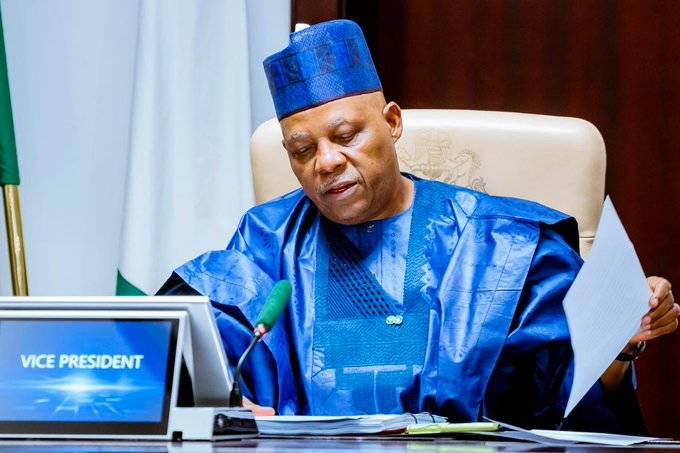
Vice President Kashim Shettima has called for a more ambitious expansion of Nigeria’s Public-Private Partnership (PPP) framework.
He said the country’s goal of building a $1 trillion economy depends on closer collaboration between public assets and private sector expertise.
Shettima made the call on Thursday at the first 2026 meeting of the National Council on Privatisation (NCP), held at the Presidential Villa, Abuja.
He reaffirmed the President Bola Tinubu administration’s drive to position Nigeria as a leading destination for global investment.
Shettima told council members that sustainable economic growth does not happen by chance but through deliberate planning, policy consistency and strong institutions.
According to him, investors are guided less by political statements and more by clarity of purpose and stability in policy direction.
“Investors do not respond to rhetoric alone,” he said.
“They respond to coherence, to clarity, and to the evidence that a country knows where it is going and dares to stay the course.”
READ ALSO
He also referenced the recent sale of the Eko Electricity Distribution Company (Eko DISCO) as a sign of improving investor confidence in Nigeria’s reform process.
However, he cautioned that overlapping regulatory roles and inconsistent policy signals remain costly challenges that could undermine progress if not addressed.
A key focus of the meeting was progress on the $500 million World Bank-backed Distribution Sector Recovery Programme, aimed at reforming Nigeria’s electricity distribution system.
The Director General of the Bureau of Public Enterprises (BPE), Ayodeji Gbeleyi, said government efforts were intensifying to eliminate estimated billing and close the country’s metering gap.
Key updates from the programme showed that Nigeria currently faces a total metering shortfall of about 5.6 million meters, while the recovery plan targets the installation of 3.22 million prepaid meters.
Bureau’s internal
So far, contracts have been signed for 1,437,000 meters, with nearly 400,000 units already installed across 11 Distribution Companies (DISCOs).
Gbeleyi also highlighted improvements in the bureau’s internal financial management, noting that the agency had cleared a three-year backlog of unaudited accounts.
He presented the audited financial statements for the year ended 31 December 2025 to the council, a development Shettima described as an important step towards strengthening accountability and public trust in reform institutions.
Concluding the session, Shettima urged the NCP to speed up the development of viable, “bankable” projects that can attract long-term investment.
He also stressed that privatised assets must be closely monitored to ensure compliance with agreements and, more importantly, deliver tangible benefits to citizens.
Shettima said the success of Nigeria’s economic ambition would ultimately depend on ensuring that privatisation and PPP initiatives translate into real improvements in services and economic output, not just policy milestones.