




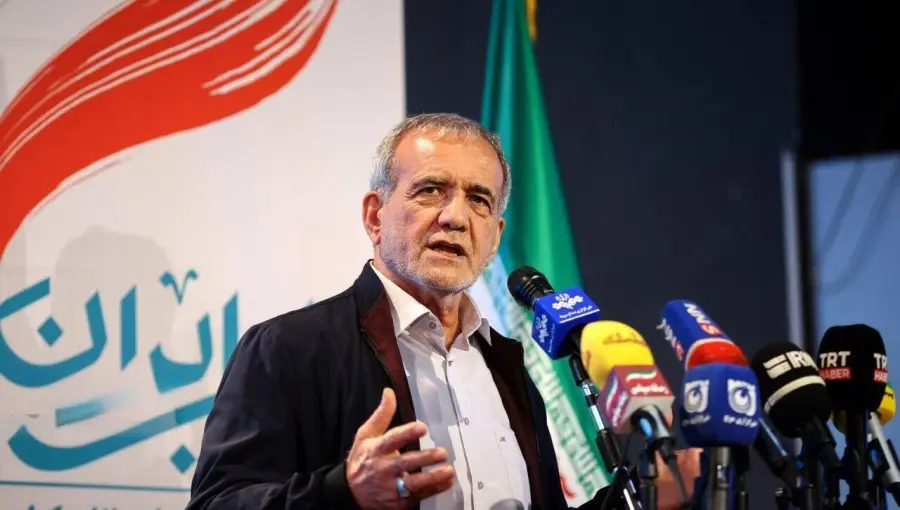
Iranian President Masoud Pezeshkian has apologised to neighbouring Gulf nations for recent missile and drone strikes.
In a televised address on Saturday, Pezeshkian announced that the country would immediately halt attacks on neighbouring territories, provided they are not used as launchpads for strikes against Iran.
This signalled a major shift in the Islamic Republic’s military posture as it entered its second week of war with Israel and the United States.
Pezeshkian spoke on behalf of Iran’s newly formed tripartite interim leadership council.
The apology comes after a week of escalating tensions in which Iranian projectiles targeted Bahrain, Saudi Arabia, Kuwait, and the United Arab Emirates—nations that have historically served as intermediaries or hosts to U.S. military assets.
Pezeshkian attributed the strikes to “miscommunication in the ranks,” a rare admission that underscores the internal turmoil following the death of Supreme Leader Ayatollah Ali Khamenei and other high-ranking officials in a February 28 airstrike.
“I should apologise to the neighbouring countries that were attacked by Iran, on my own behalf,” the President stated. “From now on, they [the armed forces] should not attack neighbouring countries or fire missiles at them, unless we are attacked by those countries. I think we should solve this through diplomacy.”
While the President adopted a conciliatory tone toward regional neighbours, he remained fiercely defiant toward the West.
READ ALSO
Addressing the ongoing “Operation Epic Fury” led by U.S. and Israeli forces, Pezeshkian rejected demands for an “unconditional surrender.”
“The United States’ demand for an unconditional surrender is a dream that they should take to their grave,” he declared, affirming that Iran’s leadership would not back down despite being “hit very hard” by hundreds of airstrikes on its military and nuclear infrastructure.
The President’s speech arrived just hours before an emergency meeting of Arab League foreign ministers, requested by Saudi Arabia, Qatar, Kuwait, and others, to discuss the Iranian aggression.
The impact of the conflict on the region has been severe, disrupting key sectors including aviation, energy and infrastructure.
Air travel was affected after operations at Dubai International Airport were partially suspended on Saturday morning when air defence systems intercepted an object over the city.
In Saudi Arabia, authorities reported that security forces successfully thwarted drone attacks targeting the Shaybah Oil Field, raising concerns over regional energy security.
Meanwhile, reports indicated that data centres operated by Amazon Web Services in Bahrain and the United Arab Emirates suffered structural damage from earlier drone strikes.
With the Supreme Leader’s seat vacant, Iran is currently governed by an interim council comprising the President, Judiciary Chief Gholamhossein Mohseni Ejei, and a senior cleric.
The move to halt strikes on neighbours is seen by analysts as an attempt to prevent a total regional coalition from forming against Tehran while it struggles to maintain command over the Revolutionary Guard (IRGC), which traditionally operates outside the elected government’s direct control.